Product engineering brief
Encapsulated & Framed Aerogel Barriers
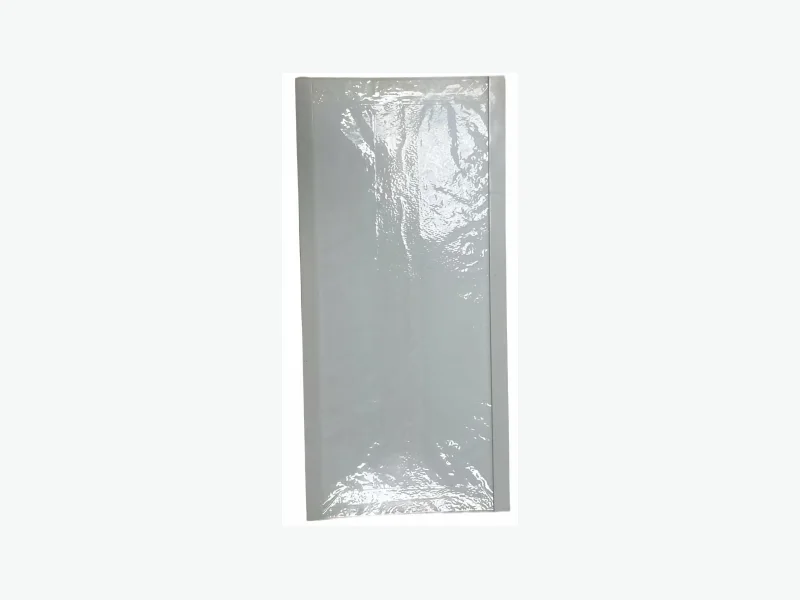
Aerogel-family cores converted with protective envelope or frame features for handling and battery integration.
The engineering problem
Start with the installed interface.
A protective envelope improves handling but changes edge geometry, thickness, dielectric behavior and the thermal bypass path.
We review core, envelope, frame, seam, adhesive and liner as one controlled construction instead of treating the core datasheet as the finished part.
Position and function
Where this component works—and what it must do
- Cell-to-cell gap
- Module end plate
- Cell top shield
- Module side barrier
- Core particle control
- Edge reinforcement
- Assembly-ready handling
- Optional location and bonding features
Selection logic
Decision data customers and engineers expect
| Decision dimension | What must be defined |
|---|---|
| Envelope | Select film or facing by temperature, electrical and handling needs. |
| Seam | Locate overlap or seal away from critical heat/electrical paths. |
| Frame | Define width, stiffness and interference with cell expansion. |
| Test | Use the final envelope and frame in validation. |
Engineering data
Available parameters and validation status
| Parameter | Value / range | Condition | Method | Evidence state |
|---|---|---|---|---|
| Available thickness | 0.50–6.00 mm | Define with application | Grade / project specific | Available range |
| Thermal conductivity | 0.012–0.030 W/m·K | Material-family screening range; verify mean temperature and method by grade | Grade / project specific | Typical material value |
| Density | 70–200 kg/m³ | Representative material-family range | Grade / project specific | Typical material value |
| Converted outline | Custom to drawing | Define with application | Grade / project specific | Customizable target |
| Thermal-runaway performance | Application test required | Cell, state of charge, geometry, compression and exposure dependent | Grade / project specific | Application validation required |
Ranges are selection windows or material-family references, not universal guarantees. Final values are tied to the approved grade, converted construction, thickness, conditioning and test method.
Data required
Send these inputs for a useful first review
- Core material or target properties
- Finished thickness and tolerance
- Envelope and edge need
- Gap, compression and heat direction
- Drawing and delivery format
Continue the evaluation
Related engineering pathways
Frequently asked questions
Clear answers before sampling
Does encapsulation keep the same conductivity?
The core value remains a material reference; the finished stack has added layers and interfaces that require separate evaluation.
Can the frame be adhesive-backed?
Potentially. Adhesive chemistry, temperature, surface and liner handling must be defined.
How are edges inspected?
Seal width, continuity, dimensional profile and visual acceptance can be added to the control plan.
Drawing-led response