Application engineering brief
Module-to-Module Thermal Protection
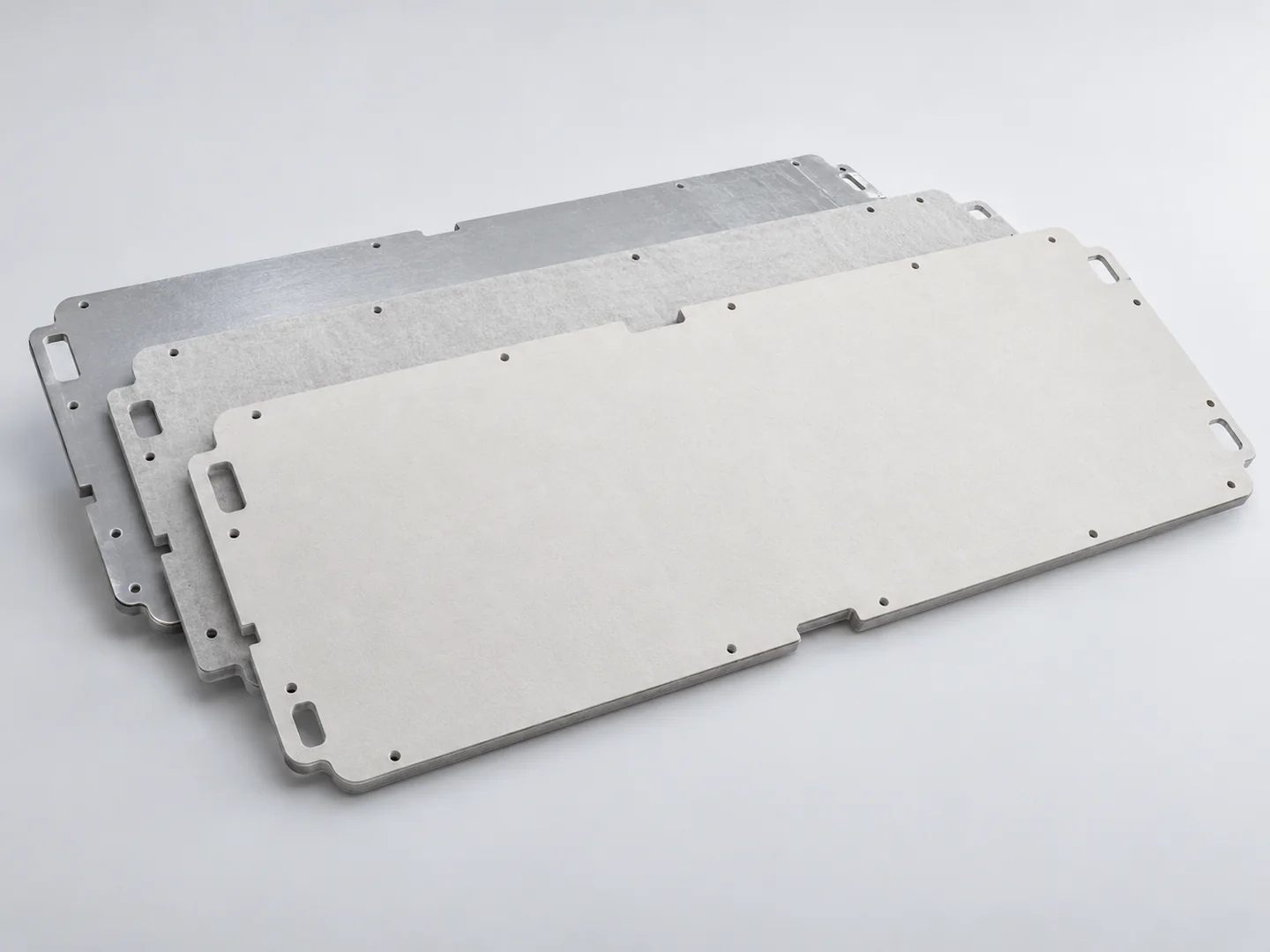
Large-format partitions and shields defined by pack geometry, mounting and the target transient exposure.
The engineering problem
Start with the installed interface.
Module-level interfaces introduce seams, penetrations, fasteners and larger unsupported areas that are absent from small material coupons.
We review material stack, sheet size, joints, edge reinforcement and handling for a manufacturable module partition.
Position and function
Where this component works—and what it must do
- Between adjacent modules
- Module wall
- Cross-car beam interface
- Pack partition
- Rack compartment
- Increase separation
- Delay radiant and conductive transfer
- Support dielectric isolation
- Protect neighboring structures
Selection logic
Decision data customers and engineers expect
| Decision dimension | What must be defined |
|---|---|
| Panel size | Confirm material width, joins and flatness. |
| Mounting | Map fasteners, adhesive, frames and thermal bridges. |
| Exposure | State side, duration, heat flux or source profile. |
| Durability | Evaluate vibration, shock and environmental aging before event testing. |
Data required
Send these inputs for a useful first review
- Pack layout and module spacing
- Panel outline and penetrations
- Mounting method
- Exposure and cold-side limit
- Mechanical and environmental conditioning
Continue the evaluation
Related engineering pathways
Frequently asked questions
Clear answers before sampling
Can large panels be supplied as one piece?
Feasibility depends on material roll or sheet width, handling and equipment. Joined constructions may require validation.
Do fasteners create thermal bridges?
They can. Attachment details should be represented in the relevant test assembly.
Is the same barrier used between cells and modules?
Material families may overlap, but thickness, stiffness, scale and exposure can be different.
Drawing-led response